
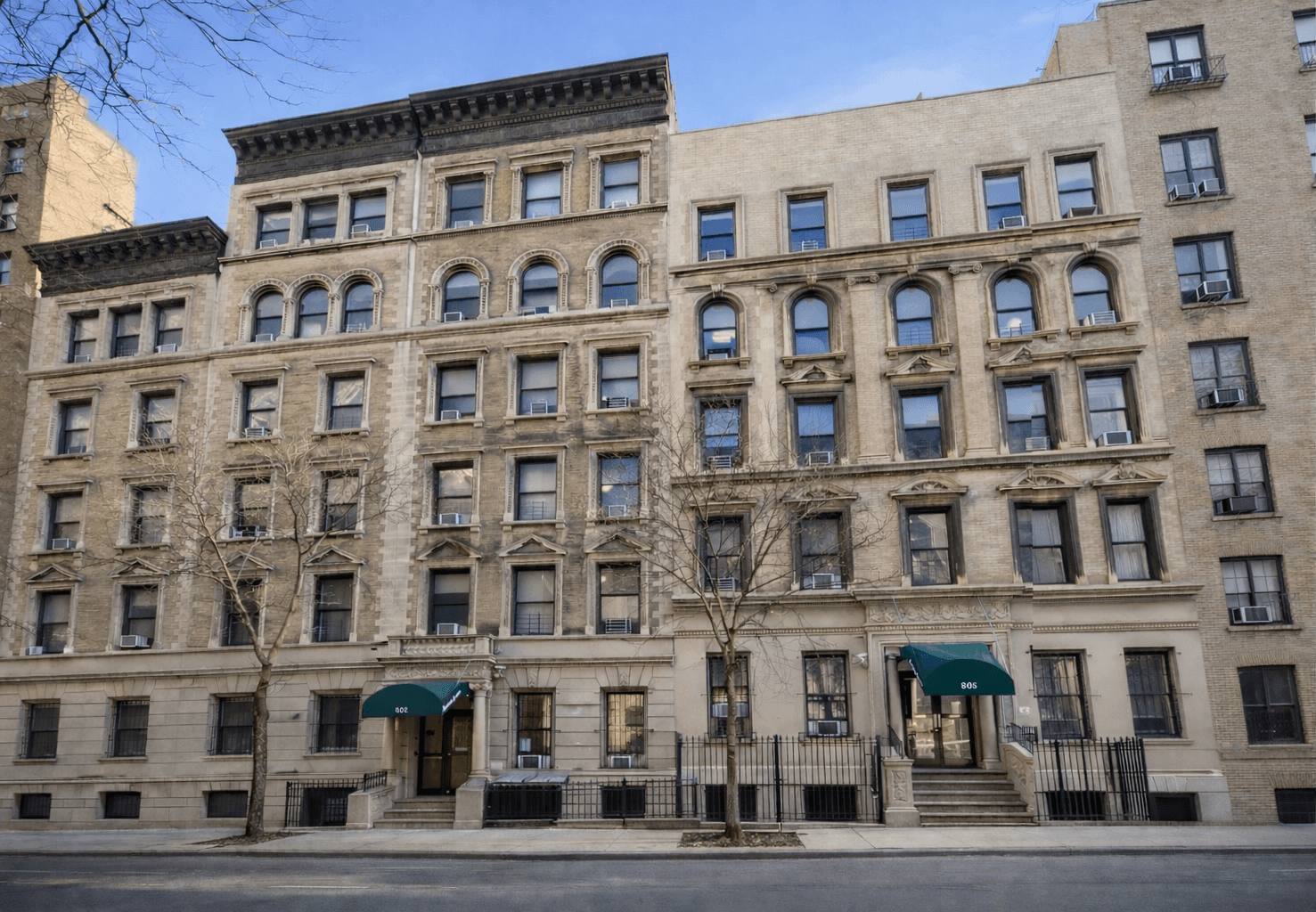
Grad student housing · Upper West Side
Manhattan Grad Student Housing on the Upper West Side
Manhattan grad student housing for the academic year, the semester, or the visiting-scholar quarter. Two prewar buildings on West 85th Street and Amsterdam Avenue, eight minutes’ walk to Juilliard, fifteen minutes by 1 train to Columbia. Furnished rooms from $420 a week, all-inclusive, no broker fee, no US guarantor.
Who this page serves
Built for graduate work in Manhattan.
Manhattan grad school is a particular kind of move: dates set by an academic calendar that rarely aligns with a twelve-month lease, a budget shaped by stipends, and a need to live close enough to a campus that you can walk home after a late seminar.
We host four archetypes through the year:
- Columbia and NYU graduate students — PhD candidates, Master’s students, MFAs.
- Juilliard and Manhattan School of Music students — performers, composers, conductors, often arriving with an instrument and looking for quiet hours.
- Cooper Union students — design, architecture, and engineering, with the East Village commute via the 1 train and a transfer.
- Visiting scholars and post-doctoral researchers — a steady international cohort, semester to academic year, often arriving on a J-1 or H-1B with no US credit history yet built.
Coliving for graduate work — quiet, well-located, transparent.
Why Amsterdam Place — Upper West Side
Where graduate students have lived for generations.
The Upper West Side is the part of Manhattan where graduate students have lived for generations. The blocks west of Amsterdam Avenue are largely prewar low-rises, lined with old trees, with Riverside Park three blocks west and Central Park two blocks east. It is leafy, walkable, and quieter than Midtown — but the 1 train puts you fifteen minutes from Columbia, and Juilliard sits an eight-minute walk south at Lincoln Center.
The neighborhood is built around the academic and cultural institutions it serves. Columbia and Barnard sit at the top of the 1 line; the Manhattan School of Music a few stops further north; Lincoln Center, Juilliard, and the Philharmonic anchor the southern edge. The Met is two subway stops south, the American Museum of Natural History four blocks north.
Grad-student coliving sits in a specific gap. It is not on-campus housing, where lease windows are rigid and roommates are assigned by the housing office. It is not a sublet, which usually means a twelve-to-fifteen-percent broker fee, a US guarantor, and a furniture run before the first seminar. It is not corporate housing, which rarely runs at academic-year prices. We borrow from hotels more than from landlords: the buildings are managed, the rooms are furnished, the WiFi is on when you arrive.
Walking & transit
Short and dense for graduate work.
The walking and transit map from West 85th Street and Amsterdam Avenue is short and dense for the schools graduate students attend:
- Juilliard School and Lincoln Center: about eight minutes’ walk south. Signature proximity moat.
- Manhattan School of Music: about twenty-five minutes via the 1 train, north to 122nd Street.
- Columbia University, Morningside Heights: about fifteen minutes door to door — three blocks west to the 1 train at 86th Street, nine stops north to 116th.
- Cooper Union, East Village: about twelve minutes by subway and walk — 1 train downtown, transfer to the 6, then a short walk to Astor Place.
- NYU Washington Square: about thirty minutes — 1 train downtown to 14th Street, then walk east.
- Medical-school corridor — Cornell-Weill, Mount Sinai: twelve to twenty minutes via crosstown and the 6 train.

The 1 train station at 86th Street sits three minutes’ walk from the front door. The 2 and 3 expresses share platforms at 96th Street one stop north — Times Square is six stops south, Wall Street the end of the line. Riverside Park along the Hudson is three blocks west, with running paths and a long stretch of waterfront. Bookshops, bagel counters, and quiet cafes are scattered along Broadway and Amsterdam between 79th and 96th. There is more on the Upper West Side neighborhood on the dedicated page.
The Building
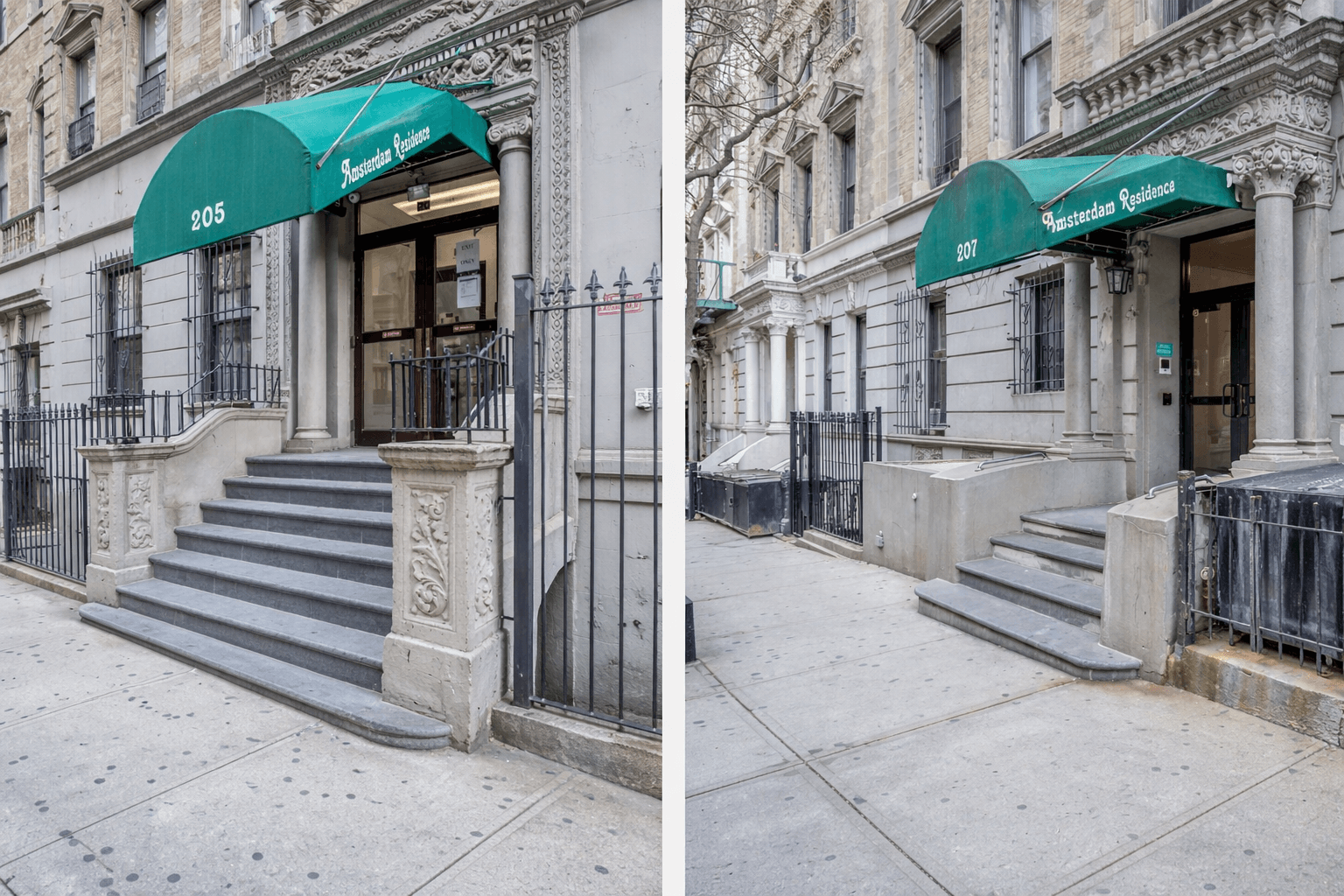
205 & 207 West 85th Street.
Amsterdam Place is two adjacent prewar buildings on West 85th Street, half a block in from Amsterdam Avenue: 205 and 207. Both date to 1910. Together they hold roughly twenty-four rooms, run as one small coliving operation rather than a chain. You can read the buildings in detail on the residences page.
The architecture is what you would expect from the period: limestone detailing on the lower facade, tall bay windows on the front rooms, original cornice lines along the rooflines. The interiors keep the prewar proportions — higher ceilings than newer construction, hardwood floors underfoot, and noticeably thicker walls than the modern thin-wall buildings most graduate students see first.
For study, the building has the things that matter:
- Quiet. Prewar walls absorb sound; the block is residential. The bars in the neighborhood are old, lit warmly, and close by midnight.
- Controlled access. Front doors and shared spaces sit on a single secure system; not a walk-up with foot traffic from the street.
- Fast WiFi. Gigabit fiber reaches every room — sufficient for a video defense or a remote lab session.
- A second study space. The ground-floor coworking lounge has bookable focus seats for days when the room becomes confining.
- A bike. Indoor bike storage at the back of the ground floor — useful for a Columbia commute on a clear morning.
Pricing & what’s included
Three room types, one transparent price.
Three room types, three weekly rates:
- Private room, shared bath: $420 a week.
- Deluxe room, shared bath: $470 a week.
- Studio with ensuite bathroom: $620 a week.
Stays are billed every four weeks. The weekly figure is the figure: no separate utility bill, no WiFi surcharge, no cleaning fee, no amenity fee. Heat, hot water, electricity, gigabit WiFi, weekly common-space cleaning, the roof deck, the coworking lounge, on-site laundry access, bike storage, and community events are all part of it. You can see the three room types for current availability.
For the comparison most graduate students will be running: an unfurnished Upper West Side studio commonly rents for $3,200 to $3,500 a month, plus a broker fee, security deposit, utility setup, and furnishing costs. A private room at Amsterdam Place is $1,680 for four weeks, all-inclusive, furnished. The model differs — shared bathroom for the lower tiers — but the all-in monthly figure sits in a comparable range for the same address.
There is no broker fee, no US credit-history requirement, and no US guarantor requirement. Proof of program enrollment — an acceptance letter, a student ID, a DS-2019 or I-20 — is typically enough. The minimum stay is four weeks, in line with the New York City law prohibiting rentals under thirty days.
How coliving works for grad students
Managed, quiet, fitted to the academic calendar.
Coliving here is not a landlord arrangement. No annual lease, no month’s-rent security deposit, no chasing utility companies, no bed-frame run on your second day in the city. The buildings are managed end to end by the same hospitality operator.
It is also not a forced community. Programming you can join, never programming you have to — a residents’ Slack, a recurring weekly dinner, the occasional museum walk. People who would rather close the door, work late, and come back to a clean room are doing exactly the right thing. A typical floor: a Columbia PhD candidate, a Juilliard violinist, a visiting scholar from Tokyo, and a Cooper Union architect a year into their MArch. Conversations happen in the kitchen, the elevator, and the laundry room — but no one assumes you owe them an explanation of where you have been all afternoon. The floor mix shifts twice a year as cohorts arrive and depart, and the building itself stays familiar through both rotations.

The common spaces support both modes — the roof deck looks east toward Central Park; the coworking lounge has bookable focus seats (see the amenities and common spaces for the full list).

The academic calendar fits the building. Fall arrivals begin in August, with a January break and a February return for the spring term common. Year-long and semester-only stays are equally routine. Move-in for international residents is built around the visa timeline, not a fixed lease date. The summer leans intern-heavy — see summer intern housing on the Upper West Side; the broader pillar runs through the broader Upper West Side coliving page. For shorter stays, see furnished short-stay rentals with no broker fee.
How to book
Four ways to start.
Four ways to start, depending on how committed you are:
- Reserve a room with no payment up front — the lightest option. Name dates and room tier; we hold it while you confirm program details. Useful when admissions or visa is still pending.
- Book a tour, in-person or virtual — we respond within one business day. International applicants commonly start with a virtual walkthrough.
- Book your stay — the direct route. Pay the service fee, secure the room, receive arrival instructions.
- Apply for a longer stay — for stays of six months or more. No US guarantor required; the application is read by the team, not by an automated screen.
If you are still weighing the address, the why the Upper West Side writeup and the Upper West Side neighborhood guide are the longer answers.
FAQ
Frequently asked questions.
Juilliard and Lincoln Center are about eight minutes south on foot. Columbia is fifteen minutes door to door — three blocks to the 1 train at 86th Street, nine stops north to 116th. Cooper Union is twelve minutes via the 1 with one transfer. NYU Washington Square is about thirty minutes. The 86th Street 1 train station is three minutes from the front door.
Find your place on the Upper West Side.
Reserve a room without payment, apply for your dates, or schedule a tour — we reply within one business day.